The WOW Campaign team has been contacted by Mr George Rolph who has indicated his intention to go on hunger and water strike in protest at the treatment of ill and disabled people by Atos Healthcare and the Department for Work and Pensions through the Work Capability Assessment (WCA).
The WOW Petition Campaign are utterly dismayed that a person would feel that this is their only option to protest. Whilst we support Mr. Rolph, and anyone else's, right to choose and their own autonomy, we truly hope that Mr. Rolph can find another way.
If anyone finds themselves in a similar position or are finding things difficult to deal with in any way then WOW Petition would advise them to contact their local GP or speak to national organisations including The Samaritans who can be contacted on 08457 90 90 90 or can be emailed at jo@samaritans.org
Additional note: WOW Campaign members have raised Mr Rolph's situation with MP's and with Mr Chris Holmes, Disability Commissioner at the Equality and Human Rights Commission.

The WOW Petition - 100,000 signatures captured. Next #WOWdebate2014 to stop the War on Welfare

10/05/2013
The Atos Inquisition
Guest post by Henry Benedict Tam @HenryBTam Author of the blog Question the Powerful
There was a time when the Spanish Inquisition hunted down those with the ‘wrong’ beliefs and made them recant their heresy. Now the British Government has rekindled its spirit, but with the aim of confronting the sick and the maimed so as to make them recant their disability.
Imagine you have been struck down by an illness, and according to your doctor, you will no longer be able to carry out work that would earn you a wage in today’s economy. For a time, you draw solace from the fact that you live under a state that maintains a genuine safety net for all, and you will not be left jobless, homeless, or having to beg for charity to keep you alive.
But then a Conservative-led Government comes along and decides that the best way to deflect public attention from its refusal to curb the excessive powers of the corporate elite is to serve up scapegoats. So it tells two and a half million people incapacitated by diverse forms of illness and injury that it will no longer pay any attention to what the doctors who have actually dealt with them have to say. Instead, it brings in the corporation, ATOS, to light the flame of recantation.
ATOS Inquisitors, armed with the mandate to interrogate and declare as many disabled people as undeserving of public support, have plunged countless vulnerable people into the deepest despair.
Examples of ATOS callousness and incompetence abound. Calling themselves ‘assessors’, they ask those summoned to appear before them questions such as “how long have you had Down’s Syndrome?” or “when did you catch autism?” A middle-aged woman, registered blind, was simply told that her benefit would be withdrawn. In another case, a 24-year-old epileptic, who was subject to grand mal seizures, had his benefit cut after he was ‘assessed’ to be fit for work. Just three months later, after living in fear that he could not pay his rent or buy food, he had a major seizure and died. People with debilitating and terminal cancer have also been told they had to surrender their benefits.
For those who managed to find help to appeal against ATOS, a third have had their assessments overturned. But many are too stressed or isolated to mount a challenge. Justice can only prevail if the entire inquisition regime is cast aside. The National Audit Office has investigated and found ATOS work to be unsatisfactory. The British Medical Association has asked for the assessment system to be scrapped.
But the Government is not relenting for one moment, even if people are dying from the fear and reality of losing what little money they had hitherto relied on to stay afloat. The Government is bringing in even more stringent inquisitional criteria to cut the provision of life-saving benefits. Meanwhile, they reward ATOS so handsomely that its chief executive is given a £1 million bonus.
If the ATOS Inquisition had featured in a dystopian novel about what a rightwing government might do, it would be decried as irresponsible scaremongering. Sadly it is all too real.
[To learn more about the Employment & Support Allowance (ESA), take the ESA Quiz. Note: the number of people claiming benefit as they are unable to work has not actually risen since 1997]
There was a time when the Spanish Inquisition hunted down those with the ‘wrong’ beliefs and made them recant their heresy. Now the British Government has rekindled its spirit, but with the aim of confronting the sick and the maimed so as to make them recant their disability.
Imagine you have been struck down by an illness, and according to your doctor, you will no longer be able to carry out work that would earn you a wage in today’s economy. For a time, you draw solace from the fact that you live under a state that maintains a genuine safety net for all, and you will not be left jobless, homeless, or having to beg for charity to keep you alive.
But then a Conservative-led Government comes along and decides that the best way to deflect public attention from its refusal to curb the excessive powers of the corporate elite is to serve up scapegoats. So it tells two and a half million people incapacitated by diverse forms of illness and injury that it will no longer pay any attention to what the doctors who have actually dealt with them have to say. Instead, it brings in the corporation, ATOS, to light the flame of recantation.
ATOS Inquisitors, armed with the mandate to interrogate and declare as many disabled people as undeserving of public support, have plunged countless vulnerable people into the deepest despair.
Examples of ATOS callousness and incompetence abound. Calling themselves ‘assessors’, they ask those summoned to appear before them questions such as “how long have you had Down’s Syndrome?” or “when did you catch autism?” A middle-aged woman, registered blind, was simply told that her benefit would be withdrawn. In another case, a 24-year-old epileptic, who was subject to grand mal seizures, had his benefit cut after he was ‘assessed’ to be fit for work. Just three months later, after living in fear that he could not pay his rent or buy food, he had a major seizure and died. People with debilitating and terminal cancer have also been told they had to surrender their benefits.
For those who managed to find help to appeal against ATOS, a third have had their assessments overturned. But many are too stressed or isolated to mount a challenge. Justice can only prevail if the entire inquisition regime is cast aside. The National Audit Office has investigated and found ATOS work to be unsatisfactory. The British Medical Association has asked for the assessment system to be scrapped.
But the Government is not relenting for one moment, even if people are dying from the fear and reality of losing what little money they had hitherto relied on to stay afloat. The Government is bringing in even more stringent inquisitional criteria to cut the provision of life-saving benefits. Meanwhile, they reward ATOS so handsomely that its chief executive is given a £1 million bonus.
If the ATOS Inquisition had featured in a dystopian novel about what a rightwing government might do, it would be decried as irresponsible scaremongering. Sadly it is all too real.
[To learn more about the Employment & Support Allowance (ESA), take the ESA Quiz. Note: the number of people claiming benefit as they are unable to work has not actually risen since 1997]
09/05/2013
A Glimpse into the US Healthcare System by Elizabeth Pope
Guest post Elizabeth Pope Twitter @popesbeats Blog Popesbeats
How this idea started about writing this blog....
One of the organizers of the wow petition asked me to provide a perspective on the US Health care system. Prior to that, Since last summer, I started providing technical assistance to a wonderful group of United Kingdom Disability Rights Advocates. They were getting ready to organize around their country and communities on the benefits, welfare and rights of people with disabilities. On twitter, they use the hashtag #WOWpetition. It is a petition surrounding the benefits of people with disabilities in the UK. It has since grown to around 37,000 signatures. There hope is to reach 100,000 so it can go forth into the British Parliament and become a legislative priority. They are moving forward at lightning speed. I am so proud of their hard work and dedication!
Background Information
Since becoming a Community Organizer and overseeing many issues affecting people with disabilities, I've applied a lot of experiences. I cover two counties right now: Monterey and Santa Cruz. San Benito is a work in progress.
In a span of four months, I am continuing to learn more about Affordable Care Act by just sitting in on many meetings related to public health care and access to care. I sit on an Access to Care Steering Committee, which is trying to figure out how to implement the Affordable Care Act with the county's support and other stakeholders. It has been an interesting time. I have sat in the Safety Net Integration Council meetings with several different entities. There is also another piece to this called 'Covered California.' Here is the website.
http://www.coveredca.com/
There is an article on the Monterey Herald's website about our public hospital Natividad having a meeting with a consultant group. They advised them that they could benefit from partnering with another hospital. This strategic plan will cost $180,000 dollars and will be completed in 4-6 weeks. They spent taxpayers money on a consulting firm. Really baffled by this.
Next, is the Dual Eligibles. Medi-cal and Medi-care. For example, when you are applying for Social Security, you would qualify for Medi-Cal and the Supplemental D portion if you are over the age of 55 or 65. For those who work in public benefits counseling, They would understand this area a lot more.
This is known as Managed Care. There is a campaign going on in our SC Net statewide network called "Making Managed Care Care". For more information about this, please refer to the www.scnetca.org. That's the SC Net otherwise known as the Systems Change Network. That is what I belong too. It is a collaborative group of Advocates all over California who work on local advocacy work in their counties and on statewide campaigns.
The other area of health care is the PPO's and HMO's. That would be Kaiser and Health Net. PPO's would be Blue Shield or some other health care provider.
In Home Supportive Services is a program in different areas of the United States. It is within the Department of Social Services government agency.
This is where an individual who needs assistance in the home can get it through a caregiver. Someone who cooks, cleans, transfers, helps then bath, shower, drives them to doctor's appointments, etc. I almost was hired a few times, but did not have the necessary paperwork in and or fingerprints.
I do hope that this background information is helpful and informative. It provides a clear picture into what health care is.
Here is my take on the health care perspective in the United States...
A Glimpse into The United States Health care System
Throughout the United States, many residents, public and state officials are preparing to implement the Affordable Care Act. It takes into effective on January 1, 2014. This will make affordable coverage to all legal residents of the United States. The positive outcomes of the Affordable Care Act are in progress. From moderating health care costs to improved health insurance.
Currently, tens of millions of Americans are benefiting from the law through
provisions that do things such as allow young adults to stay on their parents’ health plans,
seniors paying less for prescription drugs and preventative services, mandatory coverage for
children with pre-existing conditions, and eliminating lifetime caps on insurance plans,
especially for those with expensive illnesses.
The United States is experiencing an unprecedented slowing of health care cost continues increasing. In 2012 marked the fourth consecutive year of record-low growth compared to all previous years of health care spending. However, there are recognizes current problems that need to be addressed regarding the Affordable Care Act, including states denying federal Medicaid funds and looming budget cuts. States that refuse these Medicaid expansion are denying health care to millions to the most vulnerable populations.
Funding for vital health care programs is also in danger as sequestration, or acrossthe-board automatic spending cuts, are scheduled to occur on March 1, 2013.
Recommendations to Make the Health System More Effective:
Renew commitment at both national and state levels to effectively implement the
coverage expansion under ACA, particularly ensuring the poorest and most vulnerable
have access to affordable coverage.
Reach agreement in Congress and in the Administration on a plan to replace
sequestration cuts and prevent future disruptions in funding for critical health care, by
enacting fiscally- and socially- responsible alternatives to reduce unnecessary health
care spending.
Eliminate Medicare’s Sustainable Growth Rate formula and support a transition to new payment models.
Implement policies to recruit and retain primary-care physicians.
Reduce firearms-related injuries and deaths by improving access to mental health
services, supporting research on the causes and prevention of violence, and enacting
reasonable controls over access to firearms that do not infringe on constitutionally
protected rights.
Recommendations to Reduce Intrusions on the Patient-Physician Relationship:
Payment reforms must allow physicians to spend more appropriate clinical time with
their patients.
Payment and delivery reforms that hold physicians accountable for the outcomes of
care should eliminate the layers of review and second-guessing of clinical decisions
made by physicians.
Center for Medi-care and Medicad Services should harmonize the measures used in different reporting program.
Center for Medicare and Medicaid Services should provide more clinically relevant ways to satisfy the requirement that
physicians must transition to using ICD-10 codes for billing and reporting purposes.
Congress and Center for Medicare and Medicaid Services should encourage participation in quality reporting programs by
reducing administrative barriers, improving bonuses, and broadening hardship
exemptions.
The government, the medical profession, and standard-setting organizations should
work with Emergency Hospital Room vendors to improve the functional capabilities of their systems.
Medicare and private insurers should move toward standardizing claims administration
requirements, pre-authorization, and other administrative simplification requirements.
Congress should enact meaningful medical liability reforms including health courts,
early disclosure of errors, and caps on non-economic damages.
State and federal authorities should avoid enactment of mandates that interfere with
physicians’ free speech and the patient-physician relationship.
The above bullet points are some key points that are related to the Affordable Care Act. It continues everyday coming out with more new information. It is a never ending cycle.
Congress is one of the legislative bodies in our United State Governments. They make the sole decisions on various different federal bills and legislation. In my viewpoint, I feel like they are not doing a good enough job of figuring out how to implement the Affordable Care Act. For example, how much will it cost? How much will people have to pay? Is it really going to cover everyone? Those are some questions to consider. There may not be enough leverage or weight to it.
For example, Monterey County(which has cities such as Monterey, Salinas, Carmel, etc) has implemented the Low-Income Health Program(Via-Care). This was a two-year battle. Could not believe it took them that long to do it. Major credit to Jane Parker and Simon Salinas our county board of supervisors for leading the way to get this implemented.
This is a temporary program until the Affordable Care Act is fully implemented. Not sure of the current enrollment numbers. They have exceeded the amount allocated. I've been inside Natividad. It is a nice facility. This is the public hospital that provides care. However, people have suggested it should partner with another hospital to provide full health care. It would be a great idea.
Participated in larger coalition groups, other issues related to health care. It is not accessible or affordable. South County is the most under served population of low-income families, people with disabilities who cannot afford transportation to access these services. There are barriers. What can we do?
Trying to figure that part out. Add in the recent sequestration cuts. In fact, I am going to a summit this week on that very subject.
For more information about... Read these articles. They give a pretty good overview of what I am specifically talking about.
http://www.acponline.org/running_practice/payment_coding/medicare/medicare_cut_2013.htm
http://www.cms.gov/Outreach-and-Education/Outreach/FFSProvPartProg/Downloads/2013-01-03-Standalone.pdf
Final Thoughts/People with Disabilities Perspective
Through learning the in's and outs of the Affordable Care Act, Covered California and many more programs, I feel like I will have to re-learn everything again, once more information becomes available. Health care is a complex issue. That's the way it has always been. People with disabilities perspective is that nothing is affordable to the community. The cost of rising health care is becoming too expensive.
If there was a way to reduce the costs from the insurance companies, that would be ideal. For now, we are continuing to pay out of our own pockets as prices continue to skyrocket. Lots of advocacy going on around the country. Let's work together to make health care affordable not only in the United States, but around the world.
14/04/2013
ESA Fit To Work Decisions and Reconsiderations - Rough Justice for Sick and Disabled People
From October 2013 anyone wishing to appeal a fit-to-work decision
will have to ask the DWP to reconsider before
they can appeal to the tribunals service. The revised appeals process is called "mandatory reconsideration" and the government has refused to set a time limit for how long the DWP should
take to complete each case. During this time claimants who were on Employment and Support Allowance will no longer be allowed to
claim the sickness benefit and will be automatically transferred to Jobseekers Allowance or have to do without an income until a revised decision has been made.
All too often the computer-based work capability assessment results in an incorrect decision being made which can have devastating financial and emotional consequences for those concerned. There have been more than 600,000 appeals since ESA was introduced which cost an additional £50 million each year on top of the £112 million paid to Atos to carry out the assessments. In fact 38% of these decisions are overturned in the claimants favour when they appeal, casting serious doubt on the accuracy of the assessments.
The Public Accounts Committee recently investigated the contract between the DWP and Atos, the company contracted to carry out 738,000 work capability assessments in 2011-12. The report stated,
"The Work Capability Assessment may unduly penalise people with specific health problems. The one size fits all approach is not appropriate for particular groups, for example, people with mental health, rare or variable conditions. The process is too inflexible and makes it extremely difficult for individuals with particular conditions to demonstrate the impact of their conditions on their ability to work. Too often the process is so stressful for applicants that it can impact on their health. The Department should assess whether the Work Capability Assessment process is unfair to these claimants."
Negotiating the legal points of the benefit system is a complicated process and Citizens Advice estimate the success rate at appeal when people have access to legal advice and representation rises to around 80%. Ministers have responded to the alarming numbers of incorrect decisions being overturned at independent tribunals not by holding Atos and the DWP to account for their failures as recommended by the Committee, but by scrapping legal aid which helps people to challenge bad decisions and making specialist benefit advisors redundant in the process.
There is a serious and alarming possibility that in the near future sick and disabled people will be made penniless during the period of mandatory reconsideration which has no time limit to complete. ESA will no longer be paid during this time. When I asked for a reconsideration last year, I had to wait four months for the DWP to sort things out. I was lucky, I do know of people who have have been effectively left in ESA limbo for many months longer than that. Currently people can still get ESA during the reconsideration process, at a rate which is the equivalent amount to Jobseekers Allowance, provided they can obtain regular 'fit-notes' from their doctors to prove they are not capable of seeking work. The changes will deter people from pursuing justice and fail to support some of the most vulnerable people to get the benefits they need and are entitled to, leaving them to turn to family, friends, or worse, foodbanks, whilst the DWP sort out their mistake. I wrote to my MP and asked him to contact the Minister for Welfare to find out what would happen to people who had sick notes from their doctors and would not be eligible for Jobseekers Allowance because they were too ill to meet the strict conditions of applying for work attached to the benefit. The answer is not forthcoming (see letter below this post). It would appear that the government is under no legal obligation to provide an income to sick people failed by the benefits system.
Anyone needing to appeal a decision after the mandatory reconsideration will have to apply directly to Her Majesty's Court and Tribunals Service which will add confusion to an already bewildering process for many people, especially those with mental health problems and learning disabilities. Transferring people to another benefit such as Jobseekers Allowance or Universal Credit and then placing them back on ESA once they are given leave to appeal or the DWP have accepted that they are not well enough to work is going to complicate matters and cause problems, rather than simplifying the system.
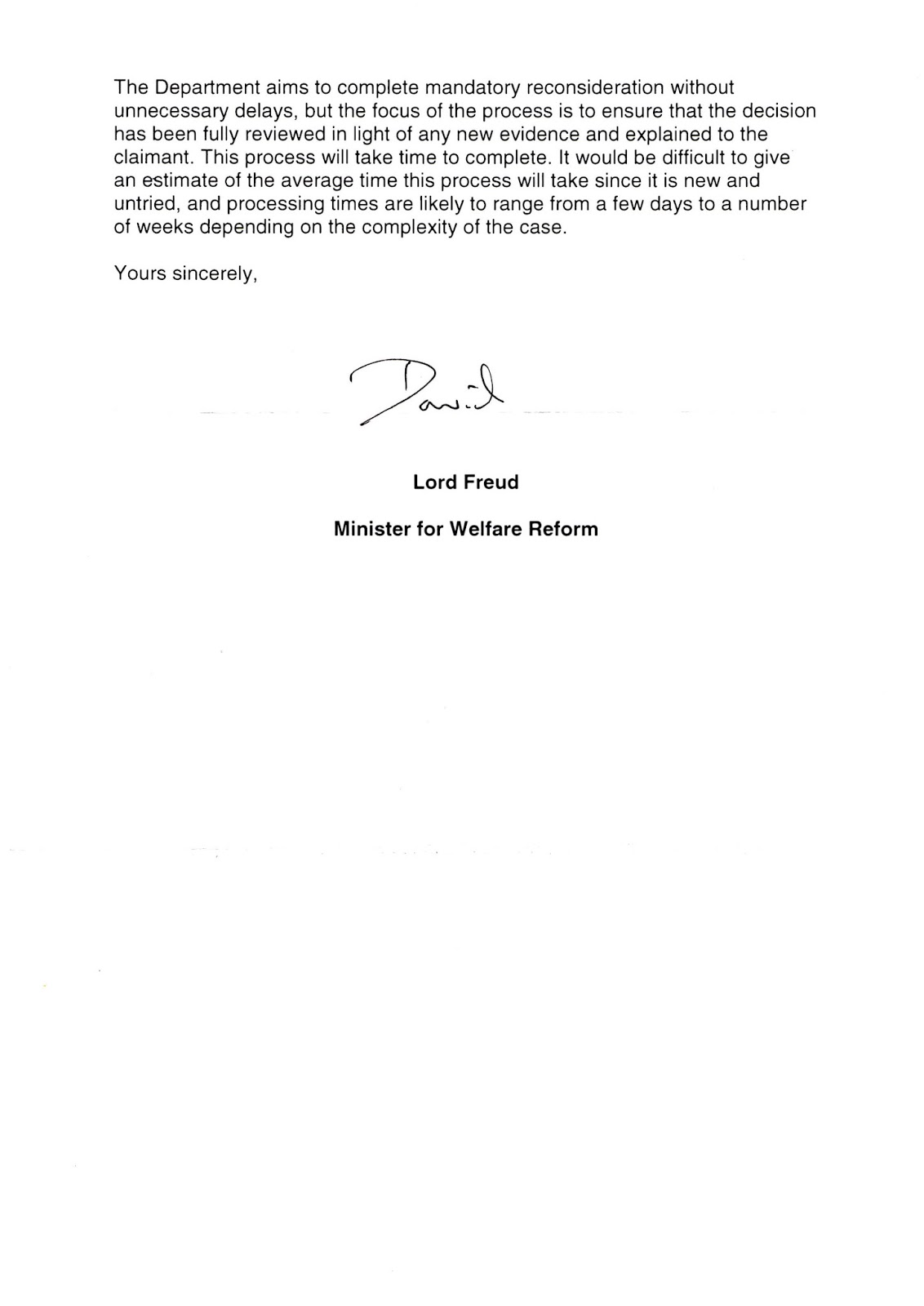
It is unlikely that a reconsideration will take less than a month, as Lord Freud, the Minister for Welfare points out in his response to Dave Watts MP,
"The length of time taken to complete mandatory reconsideration will vary from case to case. This will be dependent on whether additional medical evidence is required, and if so, how quickly it is provided by the claimant. Where the Department requests additional evidence, regulations state that the Department must allow one month for the claimants to supply it, so these cases could take in excess of one month to process."
I know how long medical records take to obtain because I've sent for my own. The very day I received my ESA50 I applied in writing for my medical history and had to pay my GP £50 for the privilege. Despite haranguing the practice manager on a regular basis, they still took six weeks to make photocopies and then I discovered that everything after 2005 was missing. Four weeks to return the ESA application and attach the relevant medical notes is farcical. Why don't they simply give people more time to gather evidence and continue to give them ESA (at the reduced rate) until the decision is sorted? I understand that some GPs and consultants are charging extortionate fees for letters relating to benefit claims. This coupled with a loss of legal aid which helped to pay for medical evidence is going to have dire consequences and be a disaster for some of the most vulnerable people the benefits system was supposed to be designed to help.
WOW Campaign is deeply concerned that the policy is being driven by the government's desire to cut the cost of appeals. The fitness-to-work tests are not fit for purpose and no justice will be served until they are scrapped and replaced with a fair assessment. We are alarmed that vulnerable claimants will be dissuaded from proceeding with their appeal because they may have no one to help them and the process is taking too long. People are waiting months from their inital application to the face-to-face assessment. Months more for a decision to be made by the DWP. Months more for their appeal to be heard and then the whole process starts again in an endless cycle of assessment and reassessment. When people are forced off ESA whilst they wait they may give up altogether. Those who turn to Jobseekers Allowance may face the possibility of being sanctioned because they are sick and not able to fulfil the conditions of seeking work, be placed on inappropriate work program placements because Jobcentre advisors are not equipped and trained to deal with incapacity and disability, and some will have to try and survive with no income at all.


Sources:
http://www.guardian.co.uk/society/2013/apr/02/disability-benefits-welfare-legal-aid
http://www.citizensadvice.org.uk/press_20130117
http://www.publications.parliament.uk/pa/cm201213/cmselect/cmpubacc/744/74402.htm
http://www.guardian.co.uk/society/2013/feb/08/dwp-fitness-to-work-fiasco
http://www.dwp.gov.uk/adviser/updates/appls-process-changesl/
http://www.publications.parliament.uk/pa/ld201213/ldhansrd/text/130213-0003.htm
http://www.nhs.uk/chq/pages/1309.aspx?categoryid=68
All too often the computer-based work capability assessment results in an incorrect decision being made which can have devastating financial and emotional consequences for those concerned. There have been more than 600,000 appeals since ESA was introduced which cost an additional £50 million each year on top of the £112 million paid to Atos to carry out the assessments. In fact 38% of these decisions are overturned in the claimants favour when they appeal, casting serious doubt on the accuracy of the assessments.
The Public Accounts Committee recently investigated the contract between the DWP and Atos, the company contracted to carry out 738,000 work capability assessments in 2011-12. The report stated,
"The Work Capability Assessment may unduly penalise people with specific health problems. The one size fits all approach is not appropriate for particular groups, for example, people with mental health, rare or variable conditions. The process is too inflexible and makes it extremely difficult for individuals with particular conditions to demonstrate the impact of their conditions on their ability to work. Too often the process is so stressful for applicants that it can impact on their health. The Department should assess whether the Work Capability Assessment process is unfair to these claimants."
Negotiating the legal points of the benefit system is a complicated process and Citizens Advice estimate the success rate at appeal when people have access to legal advice and representation rises to around 80%. Ministers have responded to the alarming numbers of incorrect decisions being overturned at independent tribunals not by holding Atos and the DWP to account for their failures as recommended by the Committee, but by scrapping legal aid which helps people to challenge bad decisions and making specialist benefit advisors redundant in the process.
There is a serious and alarming possibility that in the near future sick and disabled people will be made penniless during the period of mandatory reconsideration which has no time limit to complete. ESA will no longer be paid during this time. When I asked for a reconsideration last year, I had to wait four months for the DWP to sort things out. I was lucky, I do know of people who have have been effectively left in ESA limbo for many months longer than that. Currently people can still get ESA during the reconsideration process, at a rate which is the equivalent amount to Jobseekers Allowance, provided they can obtain regular 'fit-notes' from their doctors to prove they are not capable of seeking work. The changes will deter people from pursuing justice and fail to support some of the most vulnerable people to get the benefits they need and are entitled to, leaving them to turn to family, friends, or worse, foodbanks, whilst the DWP sort out their mistake. I wrote to my MP and asked him to contact the Minister for Welfare to find out what would happen to people who had sick notes from their doctors and would not be eligible for Jobseekers Allowance because they were too ill to meet the strict conditions of applying for work attached to the benefit. The answer is not forthcoming (see letter below this post). It would appear that the government is under no legal obligation to provide an income to sick people failed by the benefits system.
Anyone needing to appeal a decision after the mandatory reconsideration will have to apply directly to Her Majesty's Court and Tribunals Service which will add confusion to an already bewildering process for many people, especially those with mental health problems and learning disabilities. Transferring people to another benefit such as Jobseekers Allowance or Universal Credit and then placing them back on ESA once they are given leave to appeal or the DWP have accepted that they are not well enough to work is going to complicate matters and cause problems, rather than simplifying the system.
It is unlikely that a reconsideration will take less than a month, as Lord Freud, the Minister for Welfare points out in his response to Dave Watts MP,
"The length of time taken to complete mandatory reconsideration will vary from case to case. This will be dependent on whether additional medical evidence is required, and if so, how quickly it is provided by the claimant. Where the Department requests additional evidence, regulations state that the Department must allow one month for the claimants to supply it, so these cases could take in excess of one month to process."
I know how long medical records take to obtain because I've sent for my own. The very day I received my ESA50 I applied in writing for my medical history and had to pay my GP £50 for the privilege. Despite haranguing the practice manager on a regular basis, they still took six weeks to make photocopies and then I discovered that everything after 2005 was missing. Four weeks to return the ESA application and attach the relevant medical notes is farcical. Why don't they simply give people more time to gather evidence and continue to give them ESA (at the reduced rate) until the decision is sorted? I understand that some GPs and consultants are charging extortionate fees for letters relating to benefit claims. This coupled with a loss of legal aid which helped to pay for medical evidence is going to have dire consequences and be a disaster for some of the most vulnerable people the benefits system was supposed to be designed to help.
WOW Campaign is deeply concerned that the policy is being driven by the government's desire to cut the cost of appeals. The fitness-to-work tests are not fit for purpose and no justice will be served until they are scrapped and replaced with a fair assessment. We are alarmed that vulnerable claimants will be dissuaded from proceeding with their appeal because they may have no one to help them and the process is taking too long. People are waiting months from their inital application to the face-to-face assessment. Months more for a decision to be made by the DWP. Months more for their appeal to be heard and then the whole process starts again in an endless cycle of assessment and reassessment. When people are forced off ESA whilst they wait they may give up altogether. Those who turn to Jobseekers Allowance may face the possibility of being sanctioned because they are sick and not able to fulfil the conditions of seeking work, be placed on inappropriate work program placements because Jobcentre advisors are not equipped and trained to deal with incapacity and disability, and some will have to try and survive with no income at all.


Sources:
http://www.guardian.co.uk/society/2013/apr/02/disability-benefits-welfare-legal-aid
http://www.citizensadvice.org.uk/press_20130117
http://www.publications.parliament.uk/pa/cm201213/cmselect/cmpubacc/744/74402.htm
http://www.guardian.co.uk/society/2013/feb/08/dwp-fitness-to-work-fiasco
http://www.dwp.gov.uk/adviser/updates/appls-process-changesl/
http://www.publications.parliament.uk/pa/ld201213/ldhansrd/text/130213-0003.htm
http://www.nhs.uk/chq/pages/1309.aspx?categoryid=68
10/04/2013
Government admits it did not consider impact of welfare changes to disabled people
The community of sick and disabled people who collaborated to establish the WOW petition on the government’s e-petitions website has now had the opportunity to consider the official response given when you pass 10,000 signatures (we are now a third of the way to 100,000) from the Department of Work and Pensions.
Initially, we were shocked at the cursory nature and limited scope of the response. On reflection, we are disappointed and angry.
The first sentence of the petition calls for a cumulative impact assessment (CIA) of welfare reforms as they affect sick and disabled people. To paraphrase, the government has responded that they did not, indeed could not, do a CIA because the changes involved were too numerous and too complex.
We believe this constitutes a reckless disregard for the safety, health, and human rights of sick and disabled people. The DWP is saying that it embarked upon a programme of changes, which it acknowledges are the biggest changes to welfare in sixty years, without knowing what the effect would be on the most vulnerable people in society. It did not know what the impact would be, but went ahead regardless.
For a government department the size of the DWP to say that a CIA would have been too difficult is, frankly, risible. It has also been proved to be incorrect by the cross-party think tank Demos, which has carried out its own CIA.
Demos has concluded that 3.7million sick and disabled people will be negatively affected by welfare reform, with a total loss of income up to 2018 of £28.3billion.
As Demos is comparatively a small organisation with limited resources, the fact that it was able to do this CIA makes the DWP’s failure to do so remarkable, to say the least. It would appear that in reality there was no motivation within the DWP to do a CIA, and we have to ask why.
Was it because the results would completely contradict the government’s frequent assurances that disabled people would always be looked after? Did the government know that the idea of the UK’s disabled community being made dramatically poorer would have been politically unacceptable, and therefore it attempted to prevent this fact from becoming known?
The issue of a Cumulative Impact Assessment was addressed in the first sentence of the e-petition, but it is the only aspect of the petition that the government has responded to. There is no response to the request for an immediate halt to the Work Capability Assessment, as demanded by the British Medical Association in 2012 because it was harming patients.
The petition also calls for an end to ‘forced work under threat of sanctions for people on disability benefits’ and various other measures, all of which are ignored in the government response.
In conclusion, the response makes clear the government’s total and reckless lack of regard for the health, safety, wellbeing, and human rights of sick and disabled people in the UK. Consequently the Human Rights of sick and disabled people in the UK will be on the agenda for discussion at the Annual General Meeting of Amnesty International on 13/14 April 2013. For more information and to sign the
WOW Petition please go to wowpetition.com
[Shorter version available on Liberal Conspiracy]
Initially, we were shocked at the cursory nature and limited scope of the response. On reflection, we are disappointed and angry.
The first sentence of the petition calls for a cumulative impact assessment (CIA) of welfare reforms as they affect sick and disabled people. To paraphrase, the government has responded that they did not, indeed could not, do a CIA because the changes involved were too numerous and too complex.
We believe this constitutes a reckless disregard for the safety, health, and human rights of sick and disabled people. The DWP is saying that it embarked upon a programme of changes, which it acknowledges are the biggest changes to welfare in sixty years, without knowing what the effect would be on the most vulnerable people in society. It did not know what the impact would be, but went ahead regardless.
For a government department the size of the DWP to say that a CIA would have been too difficult is, frankly, risible. It has also been proved to be incorrect by the cross-party think tank Demos, which has carried out its own CIA.
Demos has concluded that 3.7million sick and disabled people will be negatively affected by welfare reform, with a total loss of income up to 2018 of £28.3billion.
As Demos is comparatively a small organisation with limited resources, the fact that it was able to do this CIA makes the DWP’s failure to do so remarkable, to say the least. It would appear that in reality there was no motivation within the DWP to do a CIA, and we have to ask why.
Was it because the results would completely contradict the government’s frequent assurances that disabled people would always be looked after? Did the government know that the idea of the UK’s disabled community being made dramatically poorer would have been politically unacceptable, and therefore it attempted to prevent this fact from becoming known?
The issue of a Cumulative Impact Assessment was addressed in the first sentence of the e-petition, but it is the only aspect of the petition that the government has responded to. There is no response to the request for an immediate halt to the Work Capability Assessment, as demanded by the British Medical Association in 2012 because it was harming patients.
The petition also calls for an end to ‘forced work under threat of sanctions for people on disability benefits’ and various other measures, all of which are ignored in the government response.
In conclusion, the response makes clear the government’s total and reckless lack of regard for the health, safety, wellbeing, and human rights of sick and disabled people in the UK. Consequently the Human Rights of sick and disabled people in the UK will be on the agenda for discussion at the Annual General Meeting of Amnesty International on 13/14 April 2013. For more information and to sign the
WOW Petition please go to wowpetition.com
[Shorter version available on Liberal Conspiracy]
Further Response to DWP Response in Detail
The government is ploughing ahead with the most ambitious reforms to the welfare system since it was introduced sixty years ago, without making any attempt to understand how sick and disabled individuals, carers and households will be affected. The reforms and cuts have been rushed through Parliament regardless of the negative consequences to the people they target.
The WOW Petition calls for a “cumulative impact assessment”. In simple terms, we want the government to understand how lots of cuts will change the life of each disabled person. The government has a duty to assess the impact of new policies on the people affected by them, but it only produces assessments based on changes to isolated benefits affecting groups, and not how changes to many benefits affect individuals. We know that these policy specific assessments are inadequate and misleading, because they do not show that the same people are losing out time and again.
The government responded to our demand for an impact assessment of its welfare reforms by suggesting that it was too difficult for them to do, and that other organisations had not produced this report. However, a recent Demos study supported by the charity Scope managed to do just that. What they discovered, was that 3.7 million disabled people are going to be hit by a reduction in income. By 2017 when the next set of reforms is expected to be announced, this group will lose £28 billion in benefits. The Chancellor also announced another round of spending cuts during the Budget, which are scheduled to happen in June 2013. That’s a whopping amount to be wiped from the welfare budget, especially when these are cuts to vital benefits that support disabled people’s basic needs. They are used to provide food, clothing, shelter, heating, transport, care services, independence and inclusion within their communities. When all of these benefit cuts are considered together, it is apparent that they are not spread out equally.
“At the ‘lucky’ end of the scale, 88,000 people currently claiming contributory ESA (WRAG) will see a double whammy of having their benefit capped by 1% through the Benefit Uprating Bill, and time limited to 12 months. At the other end of the scale – a group we might call ‘the hardest hit of the hardest hit’ – at least 1000 disabled people (up to 5000) will experience 6 separate cuts to their benefits income before the next election. By the time the next round of cuts are due, they will be £23,300 worse off per person – this represents the loss of all benefits recognising their disability (ESA and DLA), and a substantial reduction in housing benefit.
In between these two poles lies the 120,000 who will experience some form of triple cut, and 99,000 who will have a quadruple cut. At best, these represent a loss of £6309 per person by 2017. But for those unfortunate enough to lose their Disability Living Allowance early on, and who also claim contributory ESA (WRAG), the combined impact of these and the CPI (consumer price index) and 1% uprating cap will be a £23,461 loss by 2017.
For anyone, these are substantial sums of money. But for disabled people struggling with spiralling costs of living, such financial losses are life-changing.”
Five leading charities including Scope, produced a report “The Other Care Crisis” which identified a £1.2 billion funding gap in social care support for disabled people under the age of 65. The shocking conclusion was that 40% of disabled people receiving social care support are not having their basic needs met including eating, washing, dressing or getting out of the house.
Other organisations have also produced revealing reports. The Centre for Welfare Reform on behalf of the Campaign for a Fair Society, used the government’s own figures to analyse how cuts in public expenditure disproportionately target disabled people. Their assessment also looked at the cuts to local authority budgets, a great proportion which, is spent delivering social care to adults and children.
“The government seems to have made no effort to understand the cumulative impact of its cuts on minority groups, especially those with the greatest needs. It has rejected calls for a ‘Cumulative Impact Assessment’ of the cuts despite the obvious fact that those with the most severe disabilities now face the combined impact of:
- Social care cuts
- Benefit Cuts
- Housing Cuts
- Regressive Tax Increases
...it is clear that by 2015, in England alone, local government and housing will be cut by £16.2 billion. This is a cut in real terms of 41.9%. Social care for children and adults makes up 60% of all spending over which local authorities have any control. Data collected over the past two years indicates that social
care has already been cut by nearly £4 billion, and will be cut by £8 billion by 2015, a cut of about 33%. Benefits for disabled people and the poorest will also have been cut by £18 billion, a cut of about 20%.
When we look at the combined impact of all the cuts we find:
People in poverty (21% of the population) bear 39% of all cuts.
Disabled people (8% of the population) bear 29% of all cuts.
People with the most severe disabilities (2% of the whole population) bear 15% of all cuts.”
Sick and disabled people are right to be frustrated and angered by the government's refusal to listen to their concerns. The situation for many disabled people is now dire. If the government have any interest in creating a semblance of fairness in their policies they must acknowledge that the same disabled people are being targeted many times over. If the government does not share our worries, we can only conclude that it does not care about the effect of its policies on this vulnerable group of people.
We ask, why does the government not want to know the cumulative impact of its welfare reforms on sick and disabled people? This group includes people with life limiting disabilities and chronic illness who are not in a position to "make work pay" to improve their situation. They are managing ill health and disability, and already struggling to do so in circumstances of poverty and hardship. These cuts will push the poorest people towards reliance on charity and into destitution. Could it be that the government is not protecting "the frail, the vulnerable, the poorest in our society", and is failing catastrophically in its duty of care? The assessment may be complex, but perhaps it hasn’t been undertaken because it is too controversial and politically damaging. Iain Duncan Smith had said that “genuinely” disabled people have “nothing to fear” over the reforms to the welfare system, but we are far from reassured. By redefining disability, they have simply moved the goalposts. Would an assessment the many benefit cuts affecting disabled people reveal a truth that they don’t want you to know? The journalist Polly Toynbee perhaps pointed to the reason why no cumulative impact assessment has so far been undertaken. “The government relies on destitution staying silent and unseen.”
We call on the government to carry out a cumulative impact assessment of all the cuts and changes affecting sick and disabled people, their families and carers. Please add your signature to the WOW Petition http://epetitions.direct.gov.uk/petitions/43154
08/04/2013
Amnesty Members Please Vote For Resolution A5 Disability & Human Rights
If you are an Amnesty International member you can vote by proxy for Resolution A5 Disability & Human Rights in the UK a joint resolution by
WOW petition campaign http://wowpetition.com
We Are Spartacus http://wearespartacus.org.uk
CarerWatch http://carerwatch.com
Black Triangle Campaign http://blacktrianglecampaign.org
Proposed by Rick Burgess & Seconded by Nancy Farrell
& Susan Archibald, Archibald Foundation & Bangor & Ynys Mon Peace & Justice Group.
Proxy forms here, they can be emailed
http://www.amnesty.org.uk/uploads/documents/doc_23063.pdf
Deadline: 10am on Thursday 11th April
Resolution A5 Disability and human rights
Rick Burgess & Nancy Farrell
This AGM
Calls for urgent action to halt the abrogation of the Human Rights of sick & disabled people by the ruling Coalition government and its associated corporate contractors.
Calls for AIUK to urgently work with grassroots human rights campaigns by and for sick and disabled people, carers and their families.
And to set up a specialist Disability Human Rights network akin to the already existing-
- Children's Human Rights network
- Lesbian, Gay, Bisexual and Transgender network
- Teach Rights
- Trade Union network
- Women's Action network
To protect the human rights of People with disabilities, ill people and carers to halt this regressive & lethal assault on our rights.
Proposers Background Note:
Since signing the UN Convention on the Rights of Disabled People in 2009, successive British governments have not fulfilled their responsibilities. This has now resulted in between 1,300 to 10,600 people dying after having had their health benefits withdrawn over the last 3 years. Researchers and NGO’s have catalogued multiple abuses and malpractice by government agencies and contracted private corporations who administer unnecessary medical tests, which the British Medical Association has unanimously voted for to be ceased immediately. Yet they continue daily, causing immense terror in the disabled community.
Two thirds of people affected by cuts to housing and council allowances (420,000), are sick and disabled people, putting specially adapted homes and consequently health at risk. Legal aid has been withdrawn, making appeals to the court tribunal service against government administered entitlement tests all but impossible. Independent living and support will be withdrawn breaching the fundamental ethos and many articles of the Convention.
This will mean further deaths amongst vulnerable groups already victimised with rising levels of hate crime, government officials briefing media to create stigmatisation in order to enable these policies, forced labour programmes that have been ruled illegal and abusive and degrading practices administered by unqualified medical personnel.
The most recent Human Rights Joint Committee (Twenty-Third Report) by the Parliamentary Human Rights Committee found serious failings by the State to follow the UN Convention on the Rights of Disabled People and concluded the cumulative effect of polices were ‘regressive’, the UNCRPD had been ignored and had not been incorporated into UK law with the government falsely describing it as ‘soft law’ that did not need statutory standing.
31/03/2013
On the Eve of Black April, This Is How We Will Resist The War On Welfare
Have a good holiday, be assured the WOW Campaign will fight on. We are not just a petition, the petition is a tool, a key in a lock that opens the way to challenge the very seat of power in the UK. Let us tell you about our larger strategy:-
Phase One: Gain 100,000 signatures to give our demands democratic legitimacy in seeking parliamentary redress.
Phase Two: With a caucus of supportive MP's gain as much as possible in the democratic & parliamentary process to stop the human rights abuses against us and restore our health and social security systems. Including debate, free votes, Cumulative Impact Assessment and independent inquiry.
Phase Three: Where parliament and inquiries fail us we will pursue justice through the courts both national and international for the human rights abuse perpetrated by the UK government and its associated corporate allies.
You can help by getting everyone possible you can to sign the petition, we need 100,000 signatures by December 12th 2013 http://epetitions.direct.gov.uk/petitions/43154
We also want as many people to volunteer to intensify the campaign, in social media, general media, charity connections, union ties, civil society links, newsletters. email, lists and websites.
Failure is not an option because many thousands of lives are at stake. There have been too many deaths already.
We shall improvise, adapt and overcome.
When the government came and destroyed the lives of sick and disabled people, carers and families what did you do?
If you are reading this, you are the resistance.
Join Us
info@wowpetition.com
Subscribe to:
Posts (Atom)